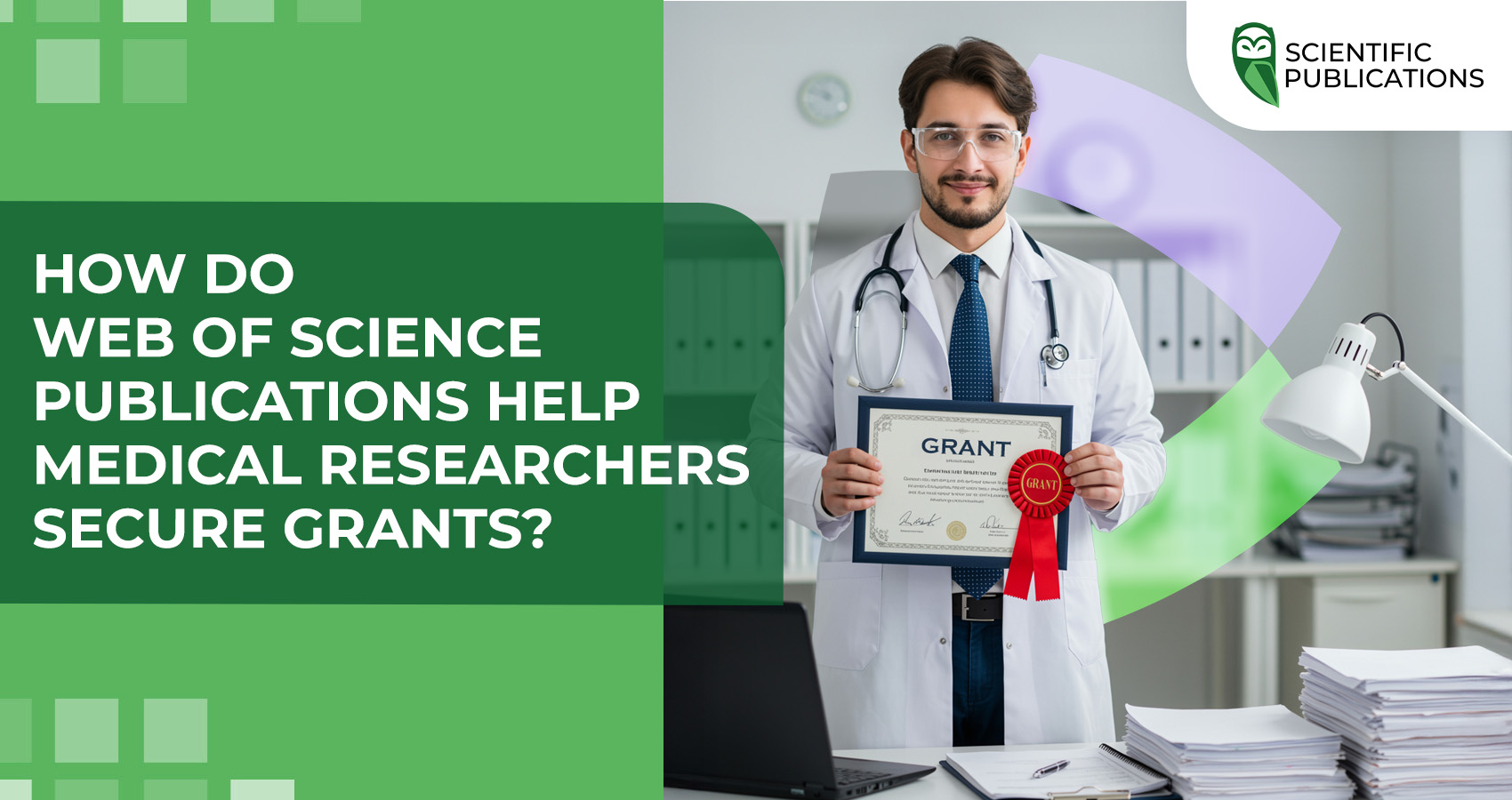
In the medical field, competition for grant funding is extremely high. Many specialists who aim to realise their ambitious research ideas often wonder whether there are ways to increase their chances of securing financial support. One of the most effective tools for doing so is publishing in Web of Science–indexed journals. Why are such publications important? How exactly do they influence a medical researcher’s grant application? Let’s explore this in detail.
Publications and grants: what is the link?
In medicine, grant competition is particularly intense because it combines clinical practice with research activities. Doctors who simultaneously conduct research including clinician-scientists, department heads, PhD students, and early-career researchers often have less time for academic work compared to non-clinical researchers. For this reason, to objectively assess a candidate’s competence and productivity, grant providers pay special attention to their achievements, the most significant of which are publications in reputable scientific journals.
There are numerous scientometric databases indexing tens of thousands of journals. However, publications indexed in Web of Science are among the most valuable and influential.
Why do grant funders prefer Web of Science?
1. A Mark of research quality
Publishing an article in a Web of Science–indexed journal is far from easy. Because the platform is considered highly authoritative within the scientific community, it imposes strict requirements on authors. Articles undergo rigorous peer review, which assesses whether the submitted work meets the journal’s standards.
For grant evaluators, this serves as clear evidence that your research approach aligns with international norms and that your results contribute meaningfully to the advancement of medicine.
2. A requirement set by grant providers
The majority of large grant programmes require applicants to have previous results published in internationally recognised sources. This is not a formality but a mandatory condition for being eligible for funding. Without such publications, applications are usually rejected during the preliminary selection stage or receive minimal scores in the “scientific competence of the applicant” criterion.
For medical doctors and researchers, this requirement is especially important. Clinical data obtained in local healthcare institutions gain international credibility only when published in journals indexed in Web of Science.
3. Assessing the Feasibility and Potential of the Project
Grant funders always evaluate not only the idea itself, but also how realistic its implementation is. Previous publications play a crucial role in this assessment.
When evaluators see that you already have published work, particularly in Web of Science–indexed journals, on a topic related to your proposed project, they gain a clear understanding of your expertise. They can review your methodologies, data, and conclusions first-hand.
This scientific foundation demonstrates that:
- you understand the current state of the problem
- you already have relevant research experience to build upon
- your new idea is a logical continuation of previous studies
Such publications significantly strengthen the credibility of your project and are often a decisive factor when choosing between applications of similar quality.
4. The disciplinary focus of Web of Science
Different databases have different disciplinary emphases. For example, Scopus tends to have broader coverage in the humanities and social sciences. Web of Science, on the other hand, places greater emphasis on exact sciences, including medicine.
It indexes many of the world’s leading medical journals, such as The New England Journal of Medicine, The Lancet, JAMA, Nature Medicine, and others, with the strictest journal selection criteria. This is why publications in Web of Science carry the most weight when medical grant applications are evaluated.
5. Trust from international partners
When a project involves collaboration with foreign clinics, universities, or research centres, potential partners will always review your Web of Science profile.
For them, this is a reliable way to confirm that:
- you publish at the international level, and your work undergoes rigorous peer review
- you are capable of conducting independent research
- your results are already known to the global scientific community
Having even a few Web of Science–indexed publications makes you a desirable and equal partner in international scientific projects. Without them, foreign collaborators often offer only secondary roles or decline cooperation altogether.
Although obtaining a grant is challenging due to the high level of competition, researchers can significantly increase their chances by applying strategic approaches. Publishing in Web of Science–indexed journals reinforces your professional reputation, demonstrates your expertise, and enhances the credibility of your application in the eyes of grant funders.
The company Scientific Publications is ready to assist you with publishing in Web of Science. We provide end-to-end support: from article auditing and journal selection to submission and successful indexing in the database. Would you like to receive a free consultation? Fill out the form below, and our manager will contact you shortly. Together to the new scientific achievements!