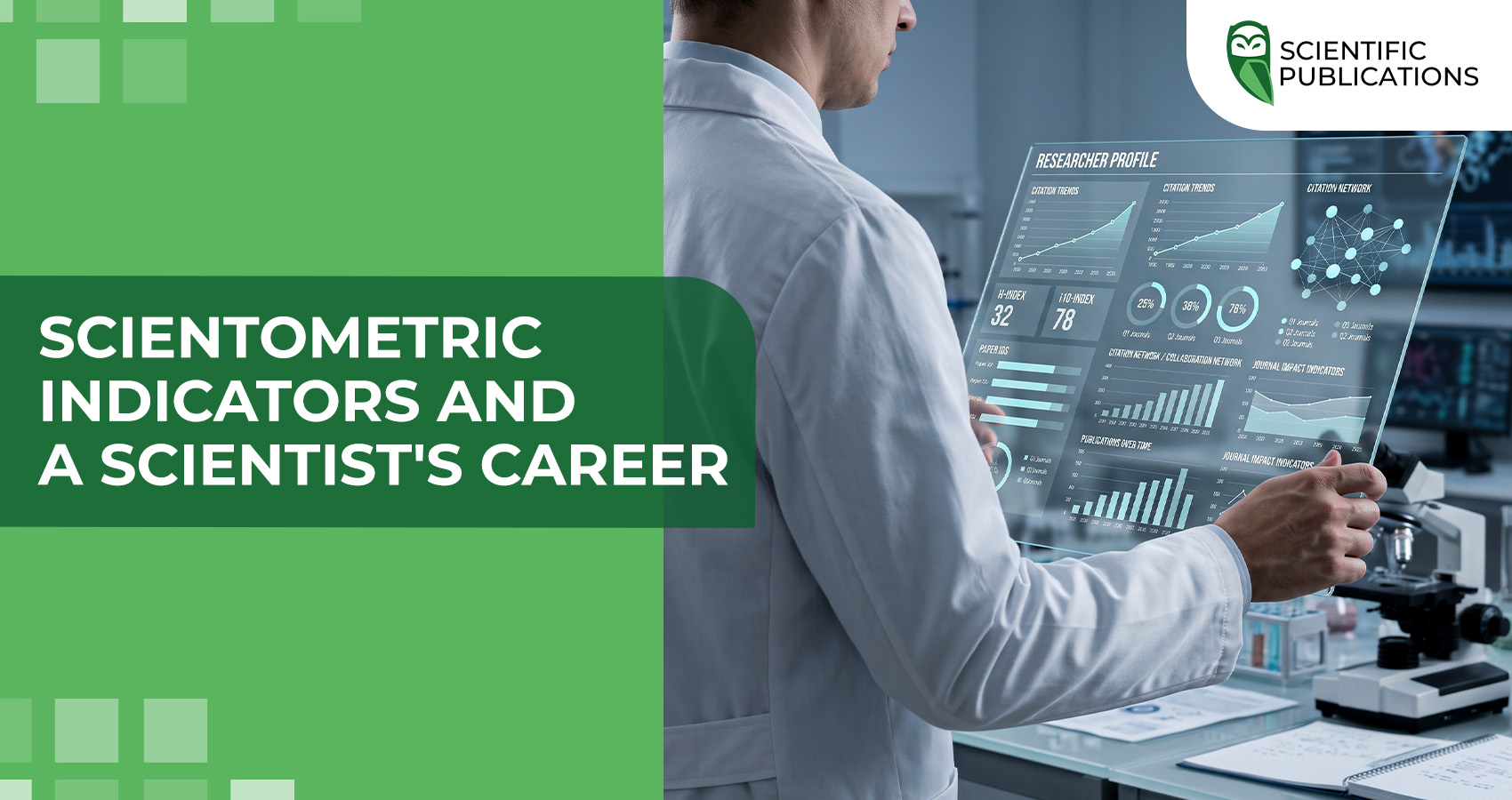
The h-index, citation counts and journal impact factor – these and other scientometric indicators are used to quantify a scientist’s academic output. They are taken into account when reviewing candidates for academic posts, allocating grants and awarding degrees and academic titles. Each indicator, however, reflects only one aspect of academic activity, and they are best considered together rather than in isolation.
What are a scientist’s scientometric indicators?
Scientometrics is the field concerned with the quantitative analysis of academic activity based on publication and citation statistics. The main indicators include the h-index, the i10-index, the journal impact factor and the journal quartile (Q1-Q4). Each is calculated using its own method and reflects a different aspect of a scientist’s academic productivity.
The main scientometric indicators taken into account when assessing academic activity include:
- the h-index
- the total number of citations
- the i10-index
- the journal impact factor
- the journal quartile in Scopus or Web of Science
Together, these indicators form a picture of a scientist’s academic activity, although none of them on its own gives a complete assessment of the quality of the research.
The h-index shapes an academic career
The h-index remains one of the most widely used indicators for assessing academic productivity. It is calculated from the ratio between the number of a scientist’s publications and the number of times they are cited: an h-index of h means that h of the author’s papers have each been cited at least h times.
This index is taken into account when reviewing candidates for university posts, allocating grants and forming research teams for international projects. The higher the h-index, the greater the likelihood that a candidacy will be viewed favourably, all other things being equal. At the same time, the indicator has its limitations: it is less informative for early-career scientists with a small number of publications and does not account for the qualitative side of citations.
How are scientometric indicators taken into account when defending a dissertation?
The awarding of academic degrees – Doctor of Philosophy and Doctor of Science – is regulated by the Higher Attestation Commission under the President of the Republic of Azerbaijan (AAK). When preparing for a defence, the commission does not assess the journal’s quartile as such, but rather whether the publication is indexed in recognised international databases – Scopus, Web of Science (including SCIE, SSCI, AHCI and ESCI) – as well as a number of subject-specific databases.
The number of publications required and the database requirements vary depending on the degree sought and the academic field. For certain natural science disciplines, for instance, obtaining a Doctor of Science degree requires that some publications appear specifically in the SCIE database. The commission also monitors the integrity of publications, rejecting work published in journals showing signs of questionable editorial practice, even where such journals are formally indexed in the databases listed above.
Publication activity determines the award of academic degrees and titles
Scientometric indicators are taken into account not only when defending a dissertation, but also when awarding the academic titles of associate professor and professor, as well as when renewing contracts and setting allowances at universities. Obtaining the title of associate professor usually requires a certain period of service after the defence of a Doctor of Philosophy degree, while the title of professor requires such service after obtaining a Doctor of Science degree. In both cases, publication activity and its reflection in recognised databases are taken into account.
Below are steps that help a scientist strengthen their scientometric profile:
- Publish articles in journals indexed in Scopus or Web of Science.
- Regularly update an author profile on Google Scholar.
- Include a correct ORCID number in all publications and applications.
- Avoid self-citation and involvement with publications showing signs of questionable editorial practice.
Following these recommendations helps ensure that a scientist’s academic contribution is more accurately reflected in scientometric databases and reduces the risk of materials being rejected at the certification stage.
Scientometric indicators serve as a tool for the quantitative assessment of academic activity, but they do not replace a substantive analysis of a scientist’s work. A considered choice of journal, compliance with the requirements of certifying bodies, and consistent work on the citability of publications all contribute to steadier progress in an academic career.
Looking to increase the citability of your publications? Specialists at Scientific Publications will analyse your scientometric profile and help you choose a journal that meets certification requirements. To receive a free consultation, fill in the form below, and our manager will contact you shortly. Onward to new academic achievements!