The success of a scientific article directly depends on the choice of the journal in which it will be published. When searching for a suitable journal, it is important to consider not only its relevance to the research topic and scientometric indicators, but also the type of access model. There are two main types of access that affect the distribution and visibility of an article: Open Access and Traditional Access. In this article, we will go into detail about the features of each access model and help you determine which one to choose for publication in Scopus.
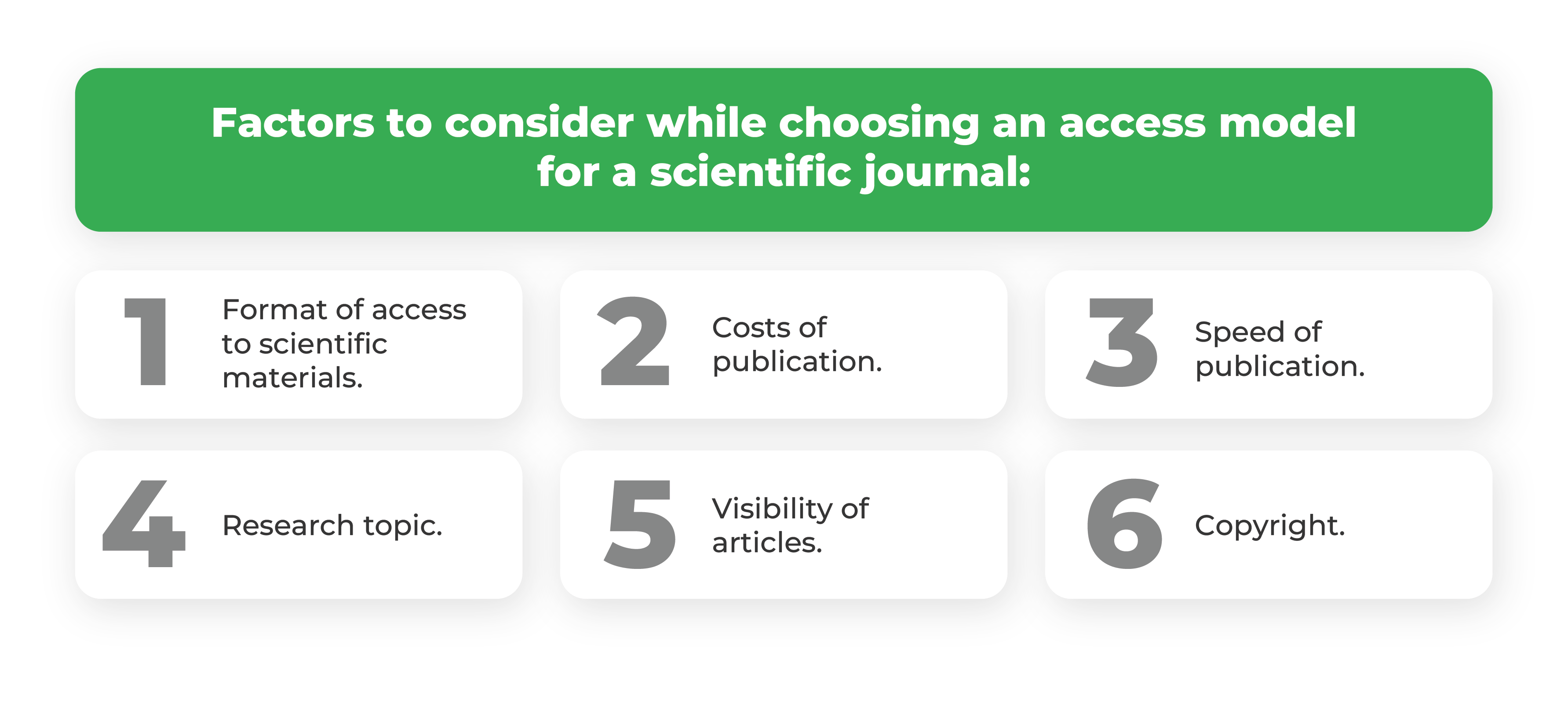
It should be noted that the choice of a journal model for publication is an individual decision of each researcher. The Open Access model, as well as Traditional Access, have their own features that may be useful for one scientist, but may not be suitable for another. The illustration below indicates the main criteria that will help in choosing the right journal option for publication.
Open Access journals
Open Access journals – are a model of scientific publishing in which users can read and download articles without the need for subscriptions or additional fees. This approach greatly enhances the accessibility of scientific research by allowing scientists, students and all interested individuals to read the work of other researchers without restriction.
This model is an alternative to traditional publishing methods, where access to scholarly content is often restricted by paid subscriptions.
In addition, there are a number of features that characterise Open Access, namely:
- Publication costs: for many academics, the issue of publication fees is one of the key aspects they pay attention to. In the case of Open Access journals, the author of a scholarly article has to pay for the placement of their research. The cost of publication varies according to the requirements of the journals.
- Format of access to scientific materials: one of the advantages of Open Access is that scientific materials are openly available to readers. This means that an interested audience can read scientific papers without paying a fee, which significantly expands the potential readership compared to the traditional publishing model where access to articles is restricted to subscriptions.
- Speed of publication: Open Access publications often use a faster peer review and publication process, allowing scientific articles to be published more quickly. This is particularly important for authors who need to publish an article before defending their thesis or dissertation.
- Research topics: open access publishing is suitable for scientists whose research is relevant to various scientific fields. Thus, the author provides access to a wide audience to his work, including scientists from other scientific fields.
- Visibility: scientific articles published in open access journals have a high number of citations. This is due to their accessibility to a wider audience, which increases the likelihood that other researchers will cite the work.
- Copyright: Authors publishing their articles in the open access usually retain the copyright to them, but provide a licence (most commonly Creative Commons) that allows for widespread use of their work. This means that anyone can read, download, copy, distribute, and use the article with attribution.
Traditional Access journals
Traditional Access journals – are scientific journals that require a subscription or payment to access published articles. In this model, scholarly material is only available to readers who have access through universities, academic institutions or individual subscriptions.
It is worth noting that Traditional Access is somewhat different from open access journals, which manifests itself in this way:
- Publication costs: in Traditional Access journals, readers or universities must pay subscriptions to access articles. As for research authors, they are not obliged to make publication fees in publications of this model.
- Format of access to scientific material: Access to material in journals with Traditional Access is restricted to those users who have a subscription. This may reduce the visibility of the work and the number of citations, especially among scientists or institutions that do not have the financial means to access paid publications.
- Speed of publication: the peer review and publication process in traditional journals can take longer as it is often more rigorous and involves additional steps such as detailed checks by reviewers and editors. This can delay the publication of an article compared to the faster process in open access journals.
- Research topic: if your research is aimed at a narrow group of specialists in a particular field, the traditional publication model will be a more appropriate choice.
- Visibility: despite their limited audience, traditional journals often have a high reputation and scientific metrics, which contributes to a higher number of citations among researchers who have access to these publications.
- Copyright: Often publishing in Traditional Access involves transferring the copyright of the article to the publisher. This means that the publisher gets the right to distribute and make other uses of the article.
The choice between Open Access and Traditional Access depends on the aims and characteristics of the research. Open Access provides a wider audience and promotes greater dissemination of knowledge, while Traditional Access journals have higher requirements for articles and focus on scientists from highly specialised scientific fields. The final decision should take into account both the author's scientific goals and possible financial and audience constraints.
To make the process of publishing an article in a scientific journal indexed in Scopus as easy as possible, contact "Scientific Publications". Our experts will help you choose the optimal model of access for publication, as well as provide support at all stages of the process, including post-publication support. For a free consultation, please leave your contact details in the form below and our manager will contact you as soon as possible. Together towards new scientific achievements!