


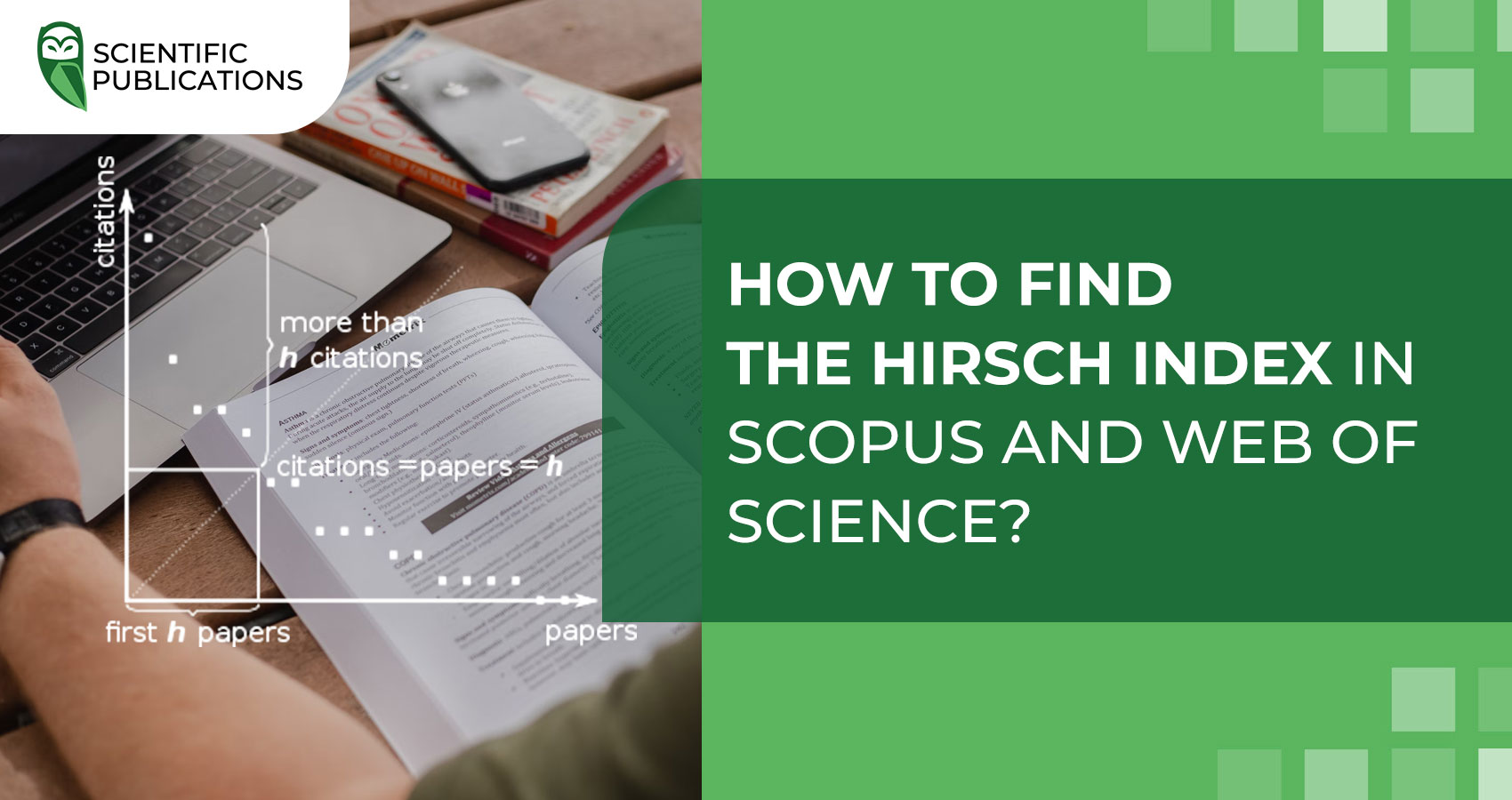
One of the most important and well-known metrics that determine the credibility of a researcher is the Hirsch index. This indicator may vary according to different databases, as publications may be indexed in journals listed in Scopus, Web of Science, or other platforms. Often, the requirements for the h-index are put forward for scientists who claim to be reviewers or editors of a scientific journal. Therefore, we will take a closer look at how to find the Hirsch index in Scopus and Web of Science.
How to find the h-index in Scopus?
- Select the "Authors" tab and enter the data to search for the author.

- Go to the profile of an author.

- The "Metrics overview" tab will display information about the number of publications (Documents by author), citations (Citations by X documents) and h-index. The "Document&Citation trends" tab shows the trends in terms of the number of publications and citations by years.

- It is also possible to trace the progression of a researcher's Hirsch Index by years. To do so, use the function "View h-graph".

- It shows detailed information about the changes in the Hirsch index.

To view a personal Hirsch index, follow the same step-by-step instructions, but go directly to the author's personal profile instead of following the searching scheme described in points 1 and 2.

How to find the Hirsch index in the Web of Science?
- Click the "Author Search" tab and type in the author's name.

- The h-index will be displayed in the author's profile.

- It is possible to access detailed data on an author's publication record, citation, and self-citation volume, as well as the dynamics of all the scientometric indicators over the years by using the "View Citation Report" feature.

The information on the Hirsch index can be obtained without access to subscription databases by using:
- Scopus Preview (for Scopus)
- Publons (for Web of Science)
Is there a reason to increase the Hirsch index?
A high Hirsch index can act as a powerful tool for promoting a researcher's credibility in the academic world:
- A scientist with a high scientometric score is more likely to be invited to collaborate with colleagues, often internationally (e.g., as a co-author).
- The Hirsch Index shows the value of the research, its significance and international relevance.
- Also, the h-index can be used as an additional tool in the evaluation of researchers. For example, if two people apply for a grant in the same field, the researcher with the highest Hirsch index is given more preference.
- Researchers with a sufficient h-index score (3-7) act as authoritative experts in a particular field and are more likely to be engaged as reviewers or editors.
- They have more influence in the scientific world and are more frequently invited to international conferences, which offers new opportunities for cooperation.
- Most often, a high Hirsch index is one of the main criteria for a funding and grant committee.
How to increase the Hirsch index?
There are different ways of managing the scientometric indicators, the most significant of which are:
- Developing an effective publication strategy. This method mostly consists of "error correction". The author analyses the scientometric indicators of their publications and determines which areas require more attention in the future. For example, by choosing more relevant topics, improving the layout of research papers, using more graphics and so on.
- Cooperation with scientific journals. Researchers aiming to improve their scientometric indicators, including the Hirsch index, should give preference to open-access journals. This will make the research more accessible for colleagues to cite. Still, it does not mean that publications in traditional business model journals are not cited at all. Usually, such articles should be of the highest standard in order for readers or libraries to pay for access and citation of the article.
- Research Promotion. Using this strategy, a scientist focuses on the publicity of the research papers by drawing attention to the article on professional forums, social media, and other services.
- Intermediary services. More and more researchers are choosing to collaborate with professionals. The company "Scientific Publications" also provides the service "Increase of the Hirsch index", which is intended to increase the Hirsch index organically. Our specialists carry out a comprehensive analysis of the author's profile in the relevant database and, through cooperation with academics worldwide, deliver a quality service.
If you need a consultation on the Hirsch index increase service, simply submit a request and our experts will contact you within one working day!
Creating science together!
Read our recent material on «10 pro tips on how to select a Scopus/WoS indexed journal for publication»


