Co-authorship is a useful practice for researchers that can help increase the visibility of scientific work, develop a researcher’s profile and strengthen academic impact. In our article, we will examine the key opportunities offered by this form of collaboration and explain how to become a co-author without violating the principles of academic integrity.
What opportunities does co-authorship offer?
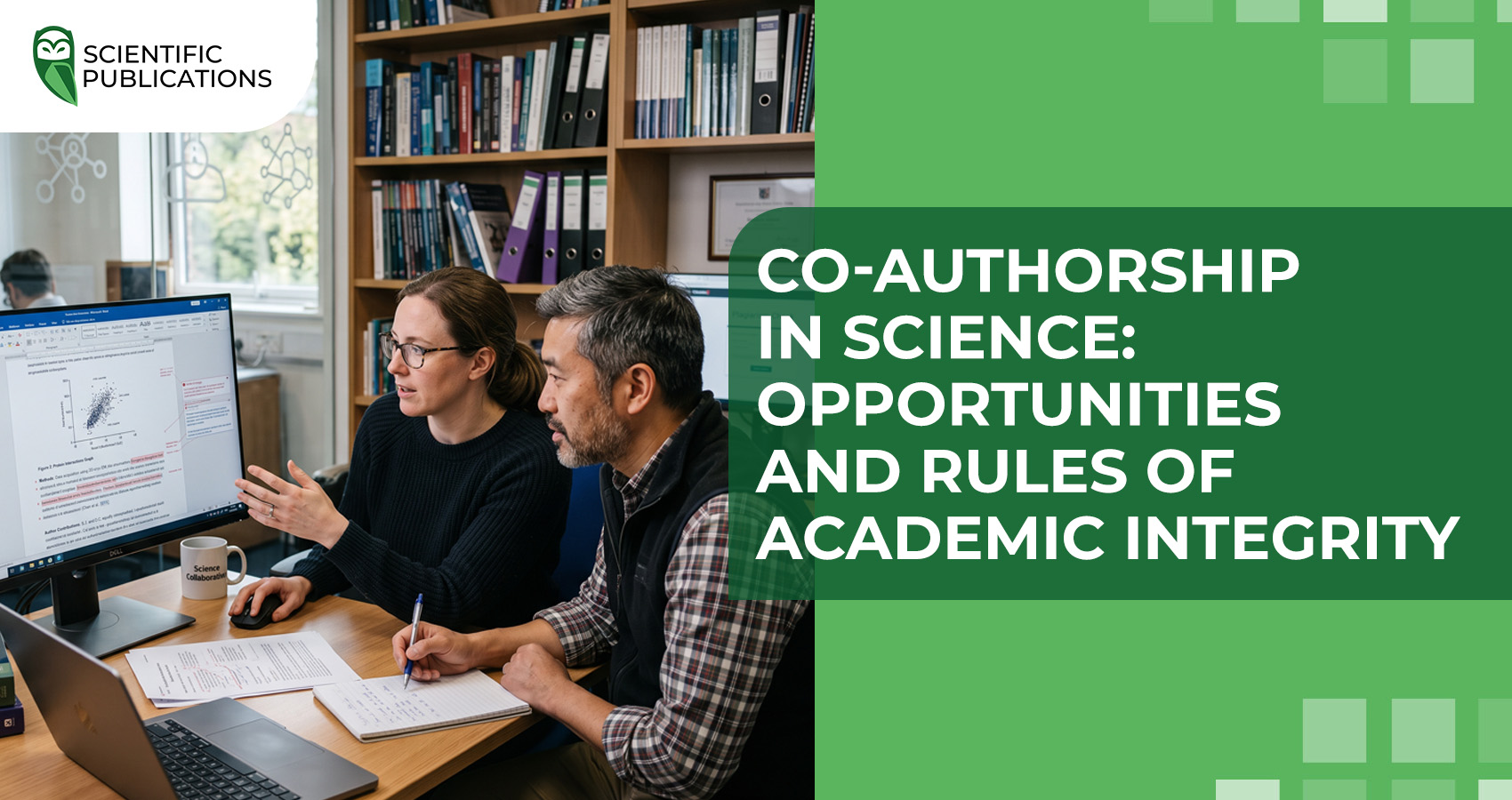
Co-authorship is a form of jointly preparing a scientific paper by several researchers, each of whom makes a substantial intellectual, scientific or practical contribution to the project. Such collaboration has many advantages, including:
- Distribution of roles. A joint project can bring together researchers with different experience and professional skills. In this way, tasks can be distributed according to the co-authors’ competencies, allowing each of them to be responsible for a separate part of the project. This format of preparation can accelerate the process of conducting the research and writing the manuscript.
- Improving the quality of the research. Co-authors can review each other’s work before the article is submitted to a journal. This makes it possible to identify errors and instances of non-compliance with the publication’s requirements before peer review.
- Increasing the visibility of the publication. During collaboration, researchers can exchange not only experience but also professional contacts. This can help increase the visibility of the publication, reach a wider audience and potentially increase its citation rate.
Who can be a co-author?
To become a co-author rather than merely a participant in the project, a specialist must make a substantial contribution to the scientific work, take part in preparing the manuscript and approve its final version. Each co-author must also be prepared to take responsibility for the reliability of the published results.
The precise criteria for determining authorship may vary depending on the scientific field and the requirements of a particular journal. However, the CRediT taxonomy, which contains 14 roles, is often used to provide a transparent description of the co-authors’ contributions. One person may perform several roles, while one role may be shared among several participants.
What is important to consider?
In addition to transparently determining the list of authors, it is also necessary to pay attention to other aspects during joint scientific work. In particular, data fabrication and falsification are unacceptable. This means that data must not be invented or altered, results must not be selectively concealed, images must not be manipulated, and methods that were not actually used in the study must not be described, and so on. Such violations may lead to the rejection of the manuscript, the retraction of an already published article and an investigation.
At the same time, the originality of the text should be ensured and plagiarism should be avoided. To achieve this, it is necessary to ensure that all borrowed ideas, methods, wording, data, tables and other materials are accompanied by appropriate references to the sources.
It is also important to disclose conflicts of interest transparently. This means that each co-author must disclose any financial, professional, personal or other relationships that may directly influence the course of the research. Failure to disclose such circumstances may constitute a violation of the journal’s requirements and the principles of publication ethics, as well as create reputational risks for the project participants.
Despite all the advantages and opportunities of co-authorship, it must be approached responsibly. In particular, the competence and reputation of potential partners should be checked, and all agreements should be recorded in writing. During the preparation of the publication, the principles of academic integrity should be observed, including checking the reliability of the data, the originality of the text and the accuracy of references to sources.
Have you encountered difficulties with the publication of a scientific article? Contact the company Scientific Publications. Our specialists will help you select a reliable publication and will support you at every stage of the publication process. Submit a request on the website, and our manager will contact you shortly. Together – towards scientific achievements!