Many scientists ask themselves: where is the best platform to publish the results of their research? There are many databases in the scientific community that index journals in different disciplines. Some of them are highly internationally recognised and cover a wide range of sciences, while others have a narrower focus and a number of limitations. In this article, we will discuss why publishing in the ERIH+ and AGRIS databases can hinder your goals and which platforms are worth choosing.
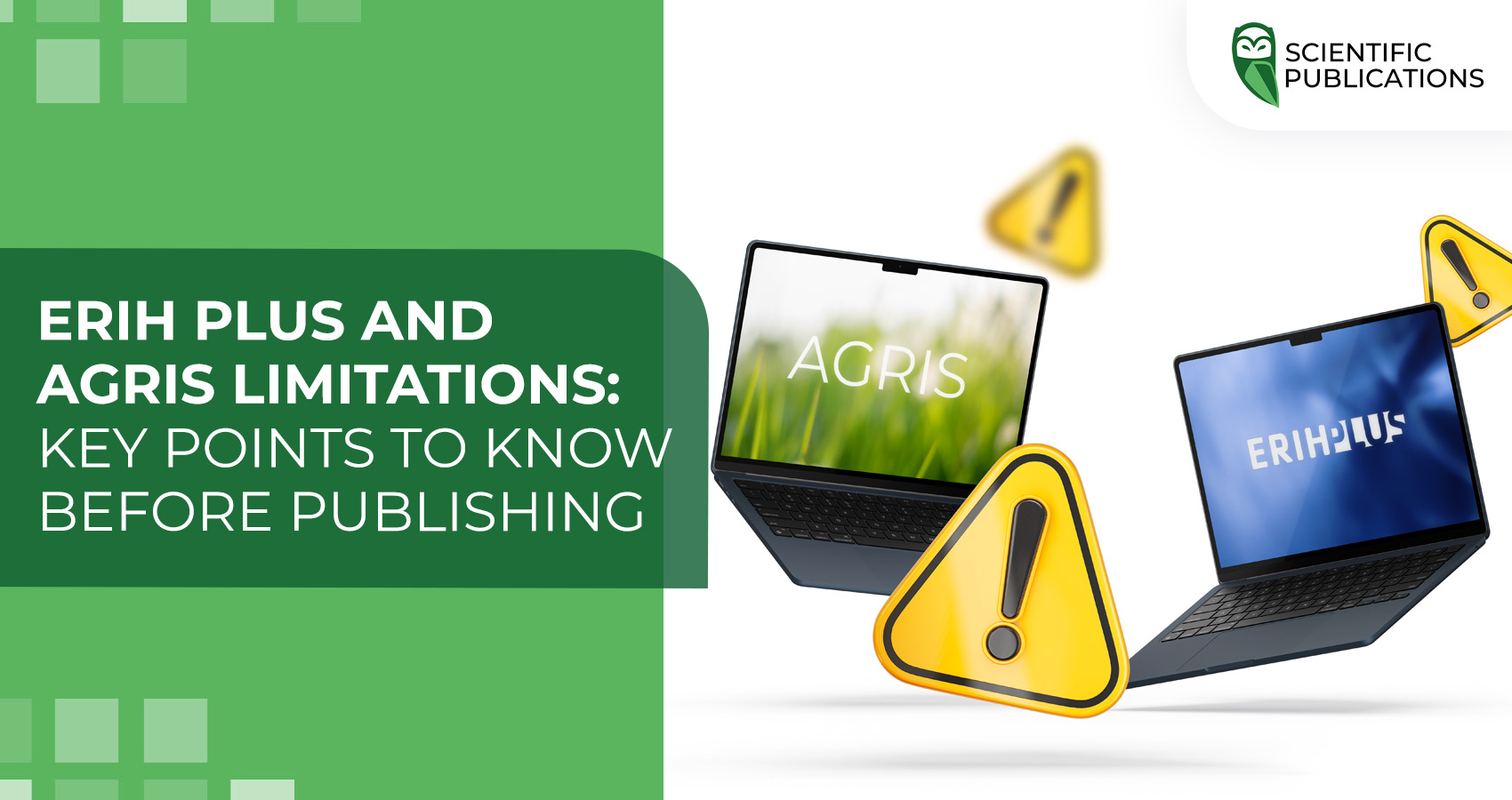
Briefly about ERIH+ and AGRIS databases
These databases enjoy considerable popularity among scientists. Each of them has its own features and focus.
ERIH+ (European Reference Index for Humanities) – is an abstract database that provides access to journals that specialise in the social sciences and humanities. In this database one can find publications in such areas as:
|
Humanities |
Social Sciences |
|
|
AGRIS – is a scientometric database created by the Food Agricultural Organisation of the United Nations that indexes publications in agricultural sciences and technologies. Accordingly, the main areas of AGRIS are:
|
Agriculture |
Related disciplines |
|
|
|
What are the limitations of ERIH+ and AGRIS?
Despite the fact that many scientists favour publishing in these databases, they have some limitations that prevent scientists from achieving their scientific goals. It is a matter of their rather narrow specialisation, which is the reason why ERIH+ and AGRIS are not universal. Why is this the case?
First, it is worthwhile to understand why researchers engage in publication activities.
There are many purposes for researchers, including:
- pursuing research degrees;
- obtaining grants and funding for research and large-scale research projects;
- Increasing visibility and recognition in the scientific community;
- career development;
- receiving allowances and payments from the university and the Quality Assurance Agency (read our article, in which we explained how exactly this can be done).
To realise each of these, a scientist needs to submit a number of publications. Their number and platform for placement are regulated by certain bodies. For example, if you are applying for a scientific degree of candidate or doctor of sciences, you need to familiarise yourself with the regulations from the dissertation committee. It is the dissertation committee that decides whether you have successfully defended your dissertation.
If you are aiming to get a large grant to conduct research, then be sure to familiarise yourself with the funding organisation's requirements for publications.
One of the main risks researchers face is that publications in ERIH+ or AGRIS journals may not be recognised by certain bodies - such as thesis councils, grant committees, certification agencies, and so on. This means that despite having an article, a scientist runs the risk that it will not be counted towards a thesis defence or grant application.
Why it's better to choose Scopus and Web of Science for publishing?
At first glance, journals indexed in ERIH+ or AGRIS may seem attractive - it is easier to publish in them, and the cost of placing an article is often much lower than in Scopus or Web of Science. This is a key argument for scientists, especially when budgets are tight.
However, there is a big risk here, as the desire to save money can turn into double costs.
As we noted above, if the chosen journal is not recognised by the responsible body, your article may not be credited. As a result, you will spend money on a publication that will not be accepted, time and miss valuable opportunities.
Moreover, in order to achieve the desired result, you will still have to submit your article to Scopus or Web of Science, which means additional costs.
To avoid this situation, you should initially choose Scopus or Web of Science databases. They are among the most authoritative platforms, and publications in them are suitable for achieving various scientific goals.
"Scientific Publications" is ready to help you choose the right journal to ensure that you can publish your article in Scopus or Web of Science. Our experts will support and accompany you at all stages of your work. If you would like to receive a free consultation, fill in the form below and our manager will contact you as soon as possible. Together to new scientific achievements!