Scientific endeavour requires considerable resources and effort on the part of researchers. Despite the complexity of the process, it has many benefits - both for science as a whole and for the researchers themselves. Research contributes to the development of specific research areas, expands the frontiers of knowledge and strengthens the academic community. At the same time, scientific research can also bring financial benefits to its authors. In this article, we will discuss in detail the ways in which scientists can monetise their work in Azerbaijan.
Scientific activity and funding: is there a link?
Many researchers wonder whether it is possible to benefit financially from their scientific work, especially if they actively publish and participate in research projects. The answer is unequivocal - yes, such a possibility exists.
In Azerbaijan, scientists' productivity is encouraged not only in the form of recognition, but also through material incentives. Depending on the country, university and field of research, there are different forms of support: from regular bonuses to one-off payments for publications.
Below, we will look in more detail at the ways in which a scientist can be financially rewarded for his or her scientific activity.
1. Agency for Quality Assurance in Education allowance
The Quality Assurance Agency in Education (TKTA) – is an authorised body that operates under the Ministry of Science and Education of Azerbaijan. Its main activities include accreditation and licensing of educational institutions, recognition of foreign qualifications, support for internal quality assurance, and assessment of knowledge and competences.
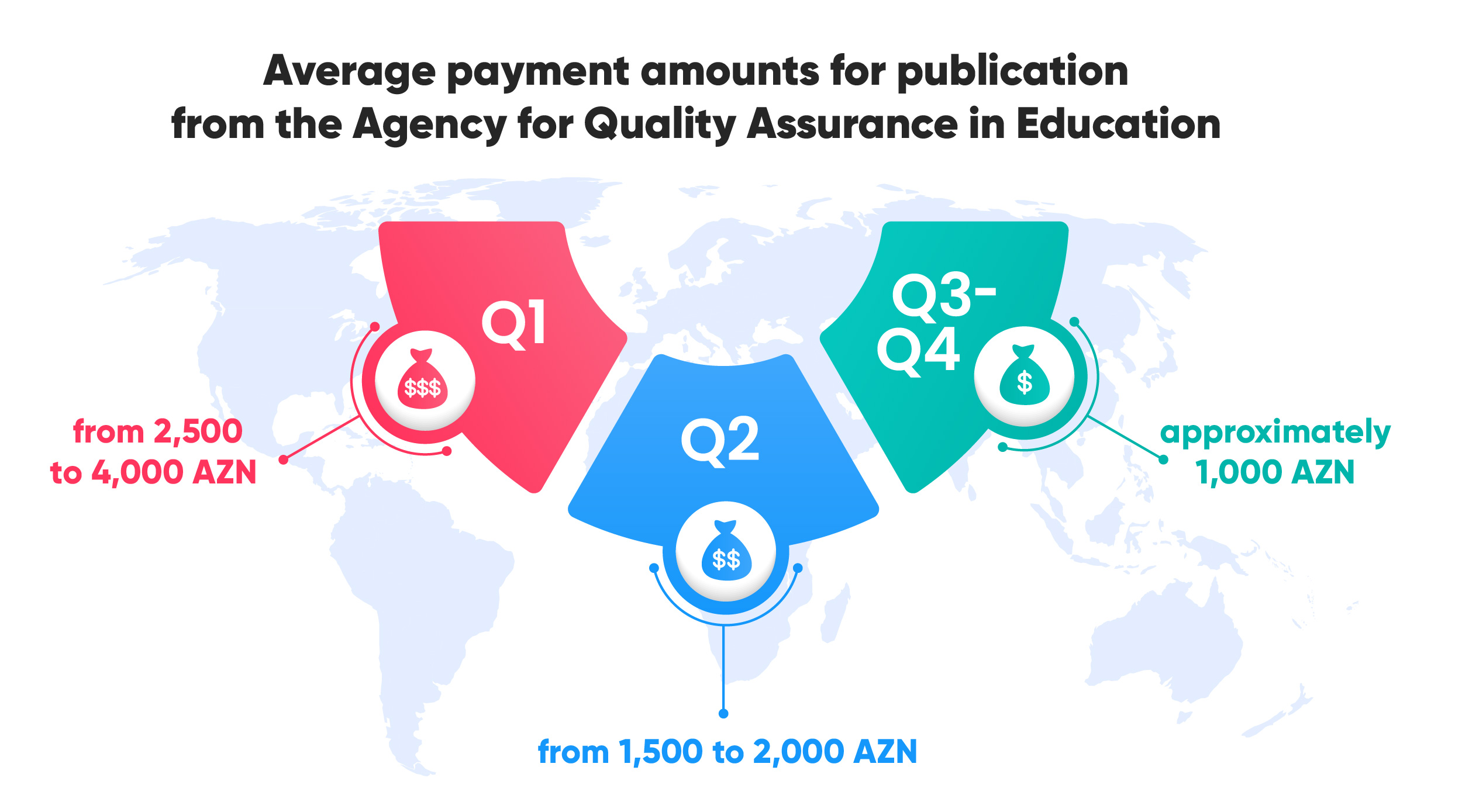
In addition, the Agency facilitates the granting of allowances to scientists for publications in international scientific journals. It should be noted that there is no single fixed amount of such payments - the amounts depend on the particular university or scientific organisation.
The amount of incentives is directly related to the quartile of the journal in which the article is published. On average, the payments are:
In order to find out more about the amount of payments, you should contact the management of your university or scientific organisation. They will not only be able to advise you on the amount of the allowance, but will also provide you with a list of the necessary supporting documentation.
To simplify this process, you can contact "Scientific Publications". We will help you to publish in the desired journal, as well as prepare the entire package of documents in accordance with the requirements of the university.
2. Differentiated salary
Another effective way to receive financial rewards is differentiated salary – a system in which the amount of a scientist's salary increases depending on his/her scientific achievements.
Important factors are publications in authoritative databases such as Scopus and Web of Science, as well as the growth of the Hirsch index, which reflects the citation of works. In addition, obtaining scientific degrees (Candidate and Doctor of Science) and academic titles (Associate Professor and Professor) also has a positive impact on the salary, especially if publications in international journals are taken into account when awarding them.
Such a system incentivises researchers to be active in research and improve the quality of their work. As in the case of bonuses from the Agency for Quality Assurance in Education, the amount of the differential salary supplement should be learnt directly from the management of your university, as the requirements and amounts may vary.
3. Co-authorship publishing
Co-publishing research papers offers researchers a number of advantages, especially in the context of monetising their work. One of the key advantages of co-authorship is the possibility to significantly reduce the financial burden on each participant.
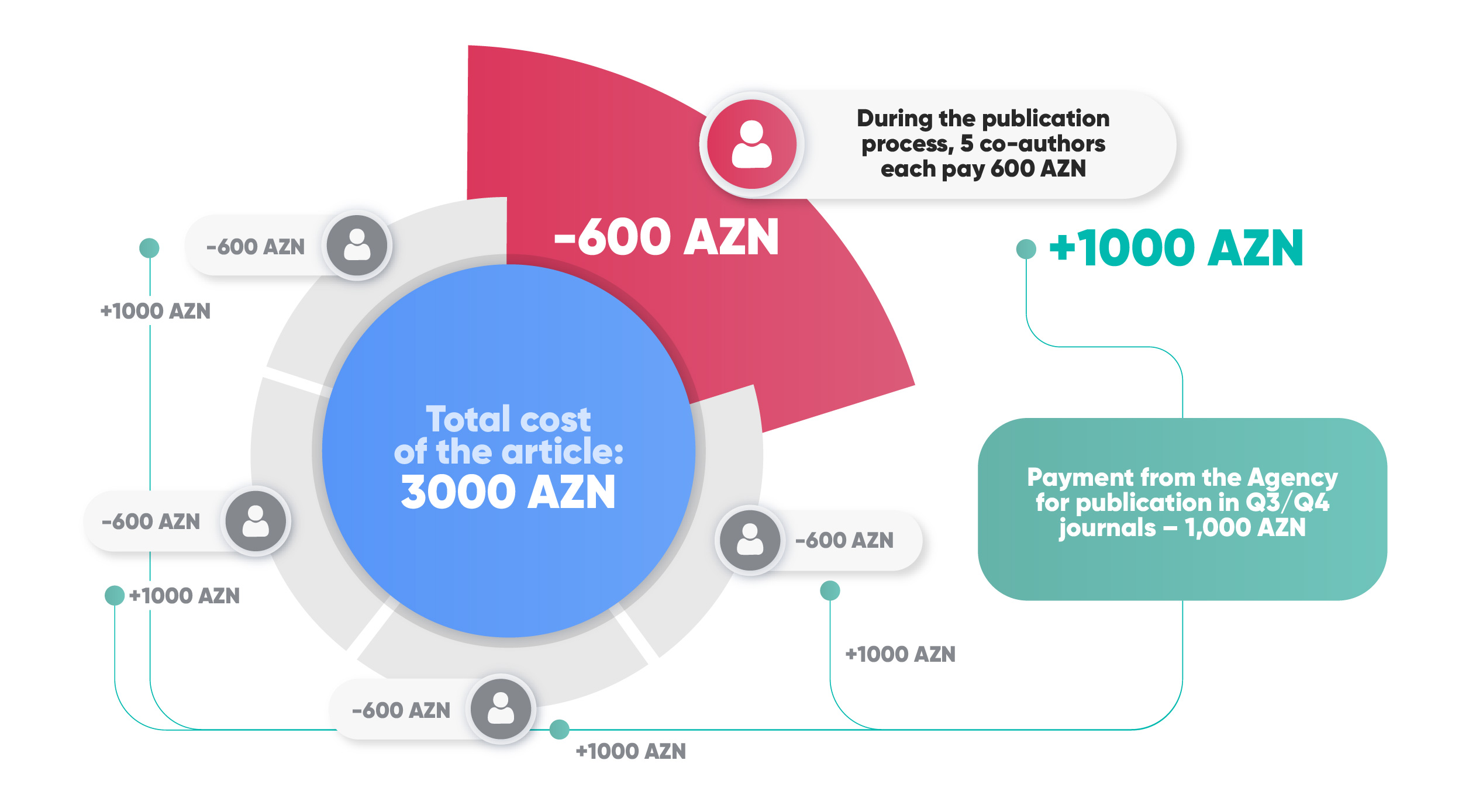
The average cost of publishing in journals indexed in Scopus is from 1600 AZN. If a group of scientists joins forces and share costs, individual costs are significantly reduced, for example, to 600 AZN per person, while each of them receives a publication in a reputable journal.
Thanks to this approach, all co-authors can qualify for allowances from the Agency for Quality Assurance in Education or receive differentiated salaries. The amount of these payments is usually much higher than the initial cost of publication.
For example, you and your colleagues paid for a publication in Scopus journal, the price of which is 3000 AZN. If you divide this sum between 5 co-authors, each of the scientists has to invest only 600 AZN. After successful publication you can receive payment for the article: for Q3/Q4 category journals the sum is about 1000 AZN. Thus, you will not only recoup your publication costs, but also get additional income and a valuable article in a prestigious database.
Take advantage of this opportunity while it is available at the price of only 600 AZN! It not only makes the publication process more affordable, but also serves as an effective tool to increase scientists' income.
Why scientists don't receive bonuses?
As noted earlier, scientists in Azerbaijan have a number of opportunities to monetise their research activities. However, many researchers do not utilise these prospects, doubting their chances of successful publication in reputable journals. They often avoid professional services, considering them irrational or too expensive.
Moreover, in an effort to save money, some scientists use the services of unproven companies that do not fulfil their obligations and do not guarantee publication. This results in wasted time, money and missed opportunities.
One common mistake among researchers is to choose highly specialised databases such as ERIH+ instead of recognised databases such as Scopus or Web of Science. In an effort to save money, many people publish in journals indexed in ERIH+, as the cost of placing an article there is usually lower. However, such savings may result in significant losses.
Publications in this database are often not recognised by dissertation councils or university supervisors when awarding bonuses. As a result, scientists have to pay twice - first for a publication in ERIH+ and then for a new article in Scopus or Web of Science.
How to avoid these problems? "Scientific Publications" offers professional support in publishing articles in prestigious journals indexed in Scopus and Web of Science. Our experts will conduct a free consultation, individually analysing the needs of each client. We help you to choose a journal that meets the requirements of your institution or scientific organisation, prepare all the necessary documents, and provide support at all stages of the publication process. Want to know more? Fill out the form below and our manager will contact you shortly. Together to new scientific achievements!